

The MTA spends $174 per passenger to take passengers to and from Randal’s Island. Don’t believe me? Do the math yourself. It’s easy and all based on publicly available government information. On average, the MTA spends $37.49 per mile to operate its buses. The M35 Randall’s Island bus route is 3 miles, so each run costs $112. Since the bus runs 184 times every weekday, the total cost per day of running this bus is $20,694. On average, the M35 has 119 passengers per weekday. That works out to $174 per passenger, which is more than it typically costs to fly from New York to Miami.
To be fair, nearly half of all bus passengers decline to pay their fair in New York City, so maybe there are twice as many passengers in reality. So let’s make that $87. But even at $87, there is something profoundly wrong here.
And this is hardly the only example. Here are the five most expensive bus routes per passenger:
| Bus | # of bus runs per weekday | Length of Route (miles) | Miles per weekday (B × C) | Cost per mile | Cost per weekday (D × E) | Average # Weekday Passengers | Cost per passenger (F ÷ G) |
|---|---|---|---|---|---|---|---|
| M35 | 184 | 3.0 | 552 | $37.49 | $20,694 | 119 | $174 |
| S55 | 54 | 10.5 | 567 | $37.49 | $21,257 | 148 | $144 |
| S54 | 79 | 11.5 | 908 | $37.49 | $34,060 | 463 | $74 |
| S56 | 52 | 9.2 | 478 | $37.49 | $17,935 | 265 | $68 |
| B39 | 58 | 1.8 | 104 | $37.49 | $3,914 | 154 | $25 |
The problem is that the MTA has a one-size-fits-all model. Buses can be quite efficient when they are heavily utilized. Take the M15 bus. It has over 10 million passengers per year, nearly 20 times as many as the M35. Moreover, it uses an articulated bus that can hold up to 59 seated passengers and even more with standing room. As a result, it only costs the MTA $4 per passenger to operate the M15:
| Bus | # of bus runs per weekday | Length of Route (miles) | Miles per weekday (B × C) | Cost per mile | Cost per weekday (D × E) | Average # Weekday Passengers | Cost per passenger (F ÷ G) |
|---|---|---|---|---|---|---|---|
| M15 | 382 | 8.7 | 3323 | $37.49 | $124,594 | 32298 | $4 |
But where the population is less dense, the logic behind using large buses diminishes. Let’s suppose that instead of having buses to Randal’s island, the MTA simply contracted with Uber to deliver passengers. Assuming that the Uber made four stops along the M35 route (which is more passengers than the M35 bus carries on average) an UberXL would only cost $34.51:
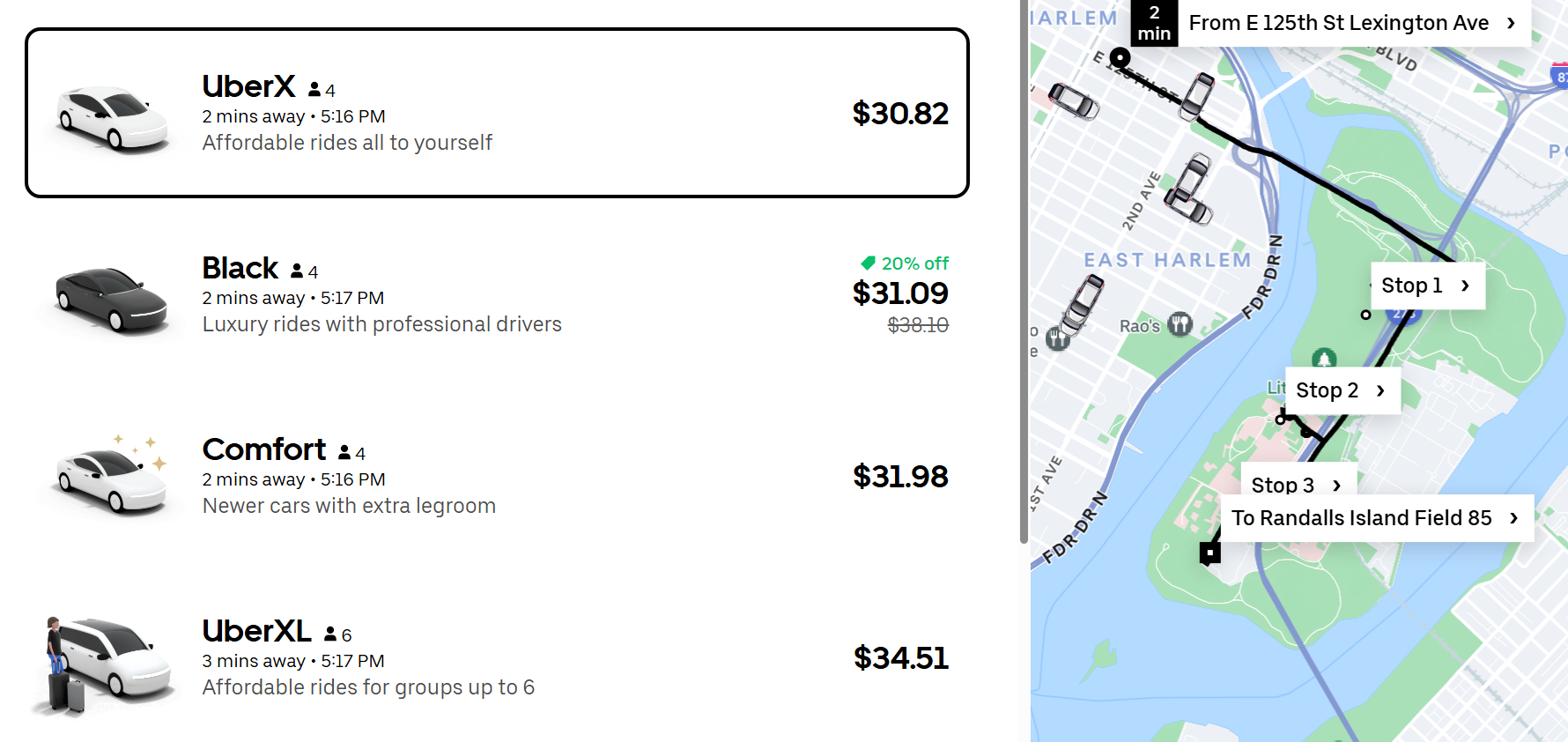
$34.51 is less than a third of the $112 that it costs the MTA to run this route with buses. Moreover, in many cases there would be fewer than four passengers and it wouldn’t be necessary to run the full route.
By running full size buses when smaller vehicles would do, we are not only wasting money but also causing harm to the environment. A full size electric bus uses more than six times as much energy as an electric car because it’s six times as heavy:

Moreover, since damage to roadways increases exponentially with weight, these buses are causing more than 64 times as much damage to the roadways as cars would.
The MTA would be better off with a more flexible approach. That is particularly true given that self-driving vehicles are right around the corner. As I explain in my other blog entries, self-driving minibuses are ready for prime time, are being tested in other cities, and will soon be far cheaper than human driven vehicles. (See this and this.) We should also be testing these vehicles in New York and a route like the M35 would be the perfect place to start.
 Reimagining NYC